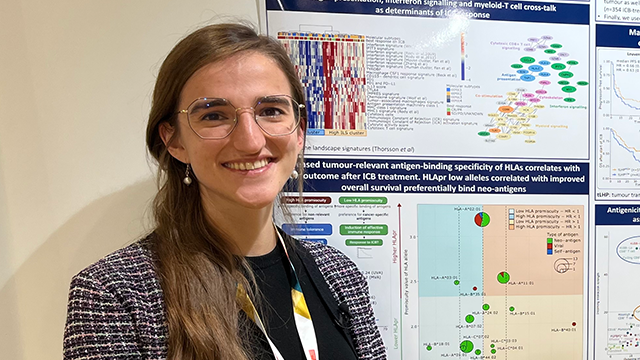
Presented by Dr Willem Lybaert (VITAZ Sint-Niklaas & University Hospital Antwerp, Belgium)
This daily highlight in head and neck cancer is presented by Dr Willem Lybaert (VITAZ Sint-Niklaas & University Hospital Antwerp), who has selected some interesting presentations from the oral abstract session on head and neck cancer at ASCO 2025.
Two studies were presented evaluating adjuvant immunotherapy for patients with locally advanced cutaneous squamous cell carcinoma of the head and neck after surgery and radiotherapy. The first, the KEYNOTE-630, a trial with pembrolizumab, showed no significant improvement in recurrence-free survival compared to placebo. In contrast, the C-POST study with cemiplimab demonstrated a clear benefit, with higher DFS at three years and a good safety profile. The difference in outcomes may be related to trial design, as the cemiplimab study enrolled higher-risk patients and initiated treatment sooner after radiotherapy. Cemiplimab has also demonstrated better efficacy than pembrolizumab in the metastatic setting, which may support its use in this context. Despite these promising findings, cemiplimab is not yet reimbursed, and patient factors such as age, comorbidities, and treatment burden must be considered. Notably, the pembrolizumab trial reported more deaths in the treatment arm, possibly influenced by COVID and patient frailty. These findings raise important questions about how best to integrate adjuvant immunotherapy into care for this vulnerable population.
Recent developments in nasopharyngeal carcinoma have indicated significant advancements in treatment strategies, particularly with the incorporation of immunotherapy. Trials have explored various settings, including neoadjuvant, concomitant, and adjuvant phases. A notable study combined immunotherapy with induction chemotherapy (gemcitabine and cisplatin), followed by radiotherapy with or without concurrent cisplatin and immunotherapy (toripalimab), then adjuvant toripalimab. The three-year failure-free survival was similar across both arms, suggesting that omitting cisplatin in the concomitant phase does not compromise efficacy but improves the side effect profile. While promising, this de-escalation approach is not yet practice-changing and requires longer-term follow-up to confirm survival outcomes. In the recurrent and metastatic first-line setting, several PD-1 inhibitors, including toripalimab, camrelizumab, tislelizumab, and penpulimab, have shown activity. Notably, a PD-L1 inhibitor, tagitanlimab, has also demonstrated a PFS benefit in combination with cisplatin and gemcitabine, marking the first PD-L1 activity in head and neck cancers. Additionally, an ADC, becotatug vedotin, has shown improved response rates, PFS, and OS in heavily pretreated nasopharyngeal carcinoma, making it the first ADC to demonstrate OS benefit in this context. These advances highlight a dynamic evolution in the management of nasopharyngeal carcinoma, with promising avenues for future shifts in the standard of care.
Salivary gland cancers remain a rare but biologically diverse group, with treatment increasingly driven by molecular targets. Two key receptors of interest are HER2 and the androgen receptor. Recent data from China introduced trastuzumab rezetecan, a novel HER2-directed ADC showing promising response rates, including in HER2-low tumours, and possibly lower rates of interstitial lung disease compared to trastuzumab deruxtecan. The therapeutic landscape for HER2-positive salivary gland cancers appears to be expanding.
For androgen receptor–positive disease, conventional therapy has involved goserelin plus bicalutamide. Previous trials with next-generation ARPIs, such as enzalutamide and apalutamide, were disappointing. However, new data on darolutamide plus goserelin showed higher response rates and longer PFS than earlier ARPIs, potentially shifting the treatment paradigm.
In anaplastic thyroid cancer, where prognosis is generally poor, a phase 2 trial of dabrafenib, trametinib, and pembrolizumab showed high response and complete resection rates, though recurrence remained an issue. Despite this, median OS improved over historical benchmarks.
We use cookies to ensure that we give you the best experience on our website. If you continue to use this site we will assume that you are happy with it.